The design is never written down
It exists as a mix of console state, Terraform, and the memory of whoever made the last change.
Agentic DevOps
Agentic DevOps for multi-cloud infrastructure.
Connect your repository. ArchitectureOS learns how your application works, proposes up to three infrastructure designs with the tradeoffs named and the running cost estimated, then generates, deploys and maintains the Terraform across AWS and GCP.
Repository to production
Understand
Read the application from your repository, and ask about what it cannot infer.
Design
You chooseUp to three designs, with the tradeoffs named, the cost estimated, and diagrams.
Validate
Terraform for a test environment, stood up at small scale before it matters.
Production
GatedGenerated and deployed only once you approve.
Operate
OngoingThe design and the Terraform stay current as the system changes.
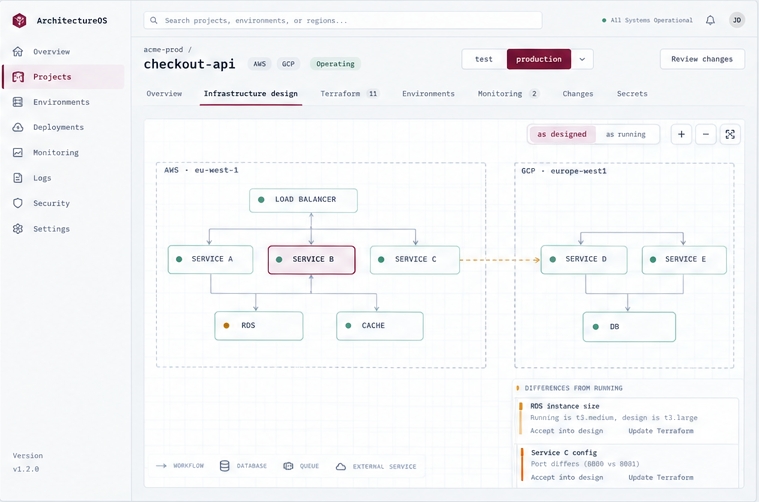
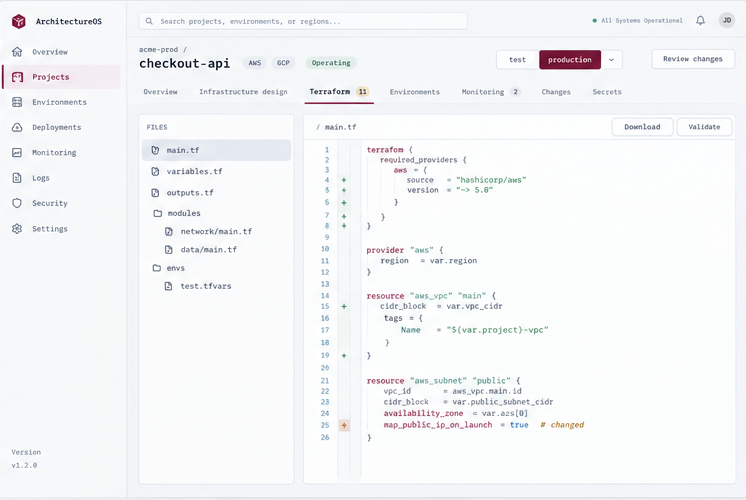
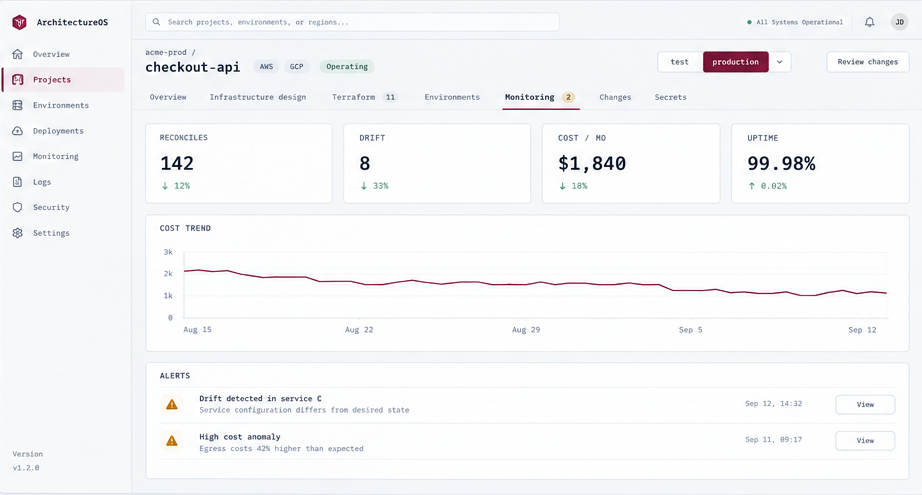
The problem
Most teams provision infrastructure reactively. A service needs a database, so one appears. Latency becomes a problem, so a cache is added. No single decision is wrong — but nobody chose the architecture, so nobody can explain it, price it, or change it safely.
It exists as a mix of console state, Terraform, and the memory of whoever made the last change.
You learn what the architecture costs from the invoice, months after the decisions were made.
Provider-specific choices accumulate one at a time, until moving anything becomes impractical.
The decisions a solutions architect would make are made by whoever happens to be on call.
Infrastructure changes are applied without knowing the cost, or the blast radius, in advance.
Why the infrastructure looks the way it does lives in a few people's heads, and leaves when they do.
How it works
Four phases. The last one never stops.
Connect your repository. ArchitectureOS reads the application and asks about what it cannot infer.
Up to three infrastructure designs, each with the tradeoffs named and the running cost estimated.
Terraform for a test environment, stood up at small scale before anything reaches production.
Deploy, then keep the design and the Terraform current as the system changes.
Two ways in
Most teams arrive with something already running. You do not need a greenfield project or a clean slate to begin.
Connect the repository and start from a clean design. ArchitectureOS works from the application outward, so the infrastructure is derived from what your system actually needs.
Start from your Terraform or CDK. We build the design from what exists, so the next change is made against a model rather than a guess.
If none exists, we assess the running system and produce the documentation for it. From that point on, the architecture is traceable.
Multi-cloud
Provider choice should follow from the architecture, not from whichever console was open when the decision was made.
Across your providers, so where a service runs is a design decision rather than an accident.
Both supported from the start, with Azure to follow as access expands.
We favour managed services that exist on more than one provider. Where a service does not, we name the lock-in explicitly instead of hiding it.
What you already run is read and understood, so new infrastructure is designed alongside it rather than in isolation.
Cost is a design input. Every design states what it will cost to run before you build it.
Trust and control
A platform that provisions infrastructure asks for more than a dashboard does. These are the rules we design to.
Write access is granted explicitly, scoped to what a step requires, and revocable at any time.
Nothing reaches production without your approval. Test environments can be created on demand and torn down.
Environment variables are held in your provider's secret manager. They never persist on our platform.
Infrastructure is delivered as Terraform in your accounts, under your own review and version control.
Blog
Notes on infrastructure design, architecture drift, and the work of keeping production correct over time.
Security reviews fail on manual architecture validation and missing evidence, not on missing policy. A maintained model turns evidence into a query.
Read the post →Nov 25, 2025 · 4 min readNew engineers take months to learn the system because dependency and ownership knowledge is tacit. Making the graph legible is faster than writing more prose.
Read the post →Nov 11, 2025 · 5 min readArchitectural truth is lost at the handoffs between design, deployment, and operations. Each boundary is a place a translation error can enter.
Read the post →Design partner program
We are working closely with a small number of teams to define how infrastructure gets designed, deployed and maintained. Design partners shape what we build first.
What partners receive
We are looking for teams running real production infrastructure — a Terraform estate, more than one environment, and architecture decisions that currently rest with one or two people.
Apply for Design Partner ProgramA few conversations, no obligation, no commitment to buy.
About
ArchitectureOS is built by engineers who have designed, deployed and operated production infrastructure. Every problem on this page is one we hit first-hand, repeatedly, and found no durable answer for.
Designing, provisioning and operating production workloads on AWS.
Building and running systems where partial failure is the normal case.
Owning the pipelines, tooling and guardrails that other engineers build on.
VPC design, routing, service meshes, and the debugging that follows.
Shipping products from first commit through to paying customers.
We publish our thinking on architecture drift and dependency mapping as we go.
Read the blog →FAQ
No. Terraform is the output, not the product. The work is understanding the application, choosing between designs that fit it, and keeping the result correct as the system changes.
No. It writes the Terraform, and you keep it. Your existing tooling and workflows stay where they are.
Read-only to begin. Write access is granted explicitly, scoped to what a step requires, and revocable — you can remove it and we lose access.
In your cloud provider's secret manager. Environment variables never persist on our platform.
No. Production changes require your approval. Test environments can be created on demand, and torn down.
AWS and GCP first, with Azure to follow. Access is opening in stages with design partners.
From your Terraform or CDK. If you have no infrastructure as code at all, we assess the running system and produce the documentation, so everything is traceable from that point on.
Teams that have to make architecture decisions and also carry the pager — usually without a dedicated infrastructure or platform function. Early access is opening with a small number of design partners.
Contact
Tell us about the infrastructure you run today. Early access is opening in stages, and design partner slots are limited.
Prefer email? Write to [email protected].